RSE Scheme New Zealand: Complete Guide 2025
Key Takeaways
◻️ The RSE scheme (Recognised Seasonal Employer) helps New Zealand farms hire RSE workers from Pacific nations when local labour isn’t enough.
◻️ Workers come on a seasonal worker visa NZ for up to 7 months in an 11-month period.
◻️ The program benefits both workers and employers: farms get reliable staff, and Pacific workers earn income and gain skills.
New Zealand relies on seasonal labour to keep its farms running. To meet this demand, the government set up the Recognised Seasonal Employer (RSE) scheme in 2007.
Under the scheme, seasonal workers can apply for a seasonal worker visa in New Zealand, which lets them work in horticulture and viticulture for a set period. Most come from Samoa, Tonga, Vanuatu, Fiji, and other Pacific countries.
So why does this matter? Because the RSE is more than a job program. It supports New Zealand’s economy while helping Pacific families through remittances. This guide will explain the RSE scheme step by step.
What is the RSE Scheme?
The RSE scheme began in 2007. It helps New Zealand farms and vineyards bring in RSE workers when local workers aren’t enough. It covers jobs like planting, harvesting, packing, and maintaining crops.
Let’s break it down:
1. Employers must be approved by Immigration New Zealand to participate.
2. They are required to apply for an Agreement to Recruit (ATR) before hiring foreign seasonal workers.
3. The scheme operates with an annual cap on the number of seasonal workers. For the 2024–2025 season, the cap is set at 20,750 seasonal workers, an increase from the previous year’s cap of 19,500. This adjustment aims to meet industry demands, particularly in sectors like wine and kiwifruit exports.
Still with me? Good. The RSE scheme plays a crucial role in supporting New Zealand’s agricultural sector by providing a reliable workforce while offering economic opportunities to workers from Pacific nations
Who can participate in RSE?
Employers
They must have RSE status, that means their farms or vineyards are approved to hire RSE workers
They must also apply for an Agreement to Recruit (ATR) before they can hire a foreign seasonal worker.
Workers
Workers need a seasonal worker visa in New Zealand, officially the Recognised Seasonal Employer Limited Visa.
To qualify, they must be 18 or older, from an eligible Pacific nation, and in good health and character.
Most can stay for up to 7 months in any 11-month period. People from Tuvalu and Kiribati can stay up to 9 months, due to distance.
Pacific nations eligible to participate in the RSE scheme
Employers in New Zealand’s horticulture and viticulture industries can recruit RSE workers from these countries under the RSE scheme, provided they meet specific criteria and have the necessary agreements in place. Pacific nations elegible are:
Fiji
Kiribati
Nauru
Palau
Papua New Guinea
Republic of the Marshall Islands
Samoa
Solomon Islands
Timor-Leste (added from 28 April 2025)
Tonga
Tuvalu
Vanuatu
How the RSE Scheme works?
The RSE scheme is designed to be straightforward for both employers and workers. Here’s how it operates:
1. Employer Accreditation: Employers must first obtain Recognised Seasonal Employer (RSE) status from Immigration New Zealand. This accreditation ensures they meet specific criteria, including financial stability and adherence to employment laws.
2. Agreement to Recruit (ATR): Once accredited, employers apply for an Agreement to Recruit (ATR). This agreement outlines the terms under which they can hire RSE workers from eligible Pacific nations.
3. Recruitment Process: Employers can recruit workers directly or through approved recruitment agents in the workers’ home pacific countries. The recruitment process includes ensuring that seasonal workers have valid job offers and meet health and character requirements.
4. Visa Application: Workers apply for the Recognised Seasonal Employer Limited Visa, which allows them to work in New Zealand for up to 7 months within an 11-month period. The visa is employer-specific, meaning seasonal workers can only work for the employer listed on their visa.
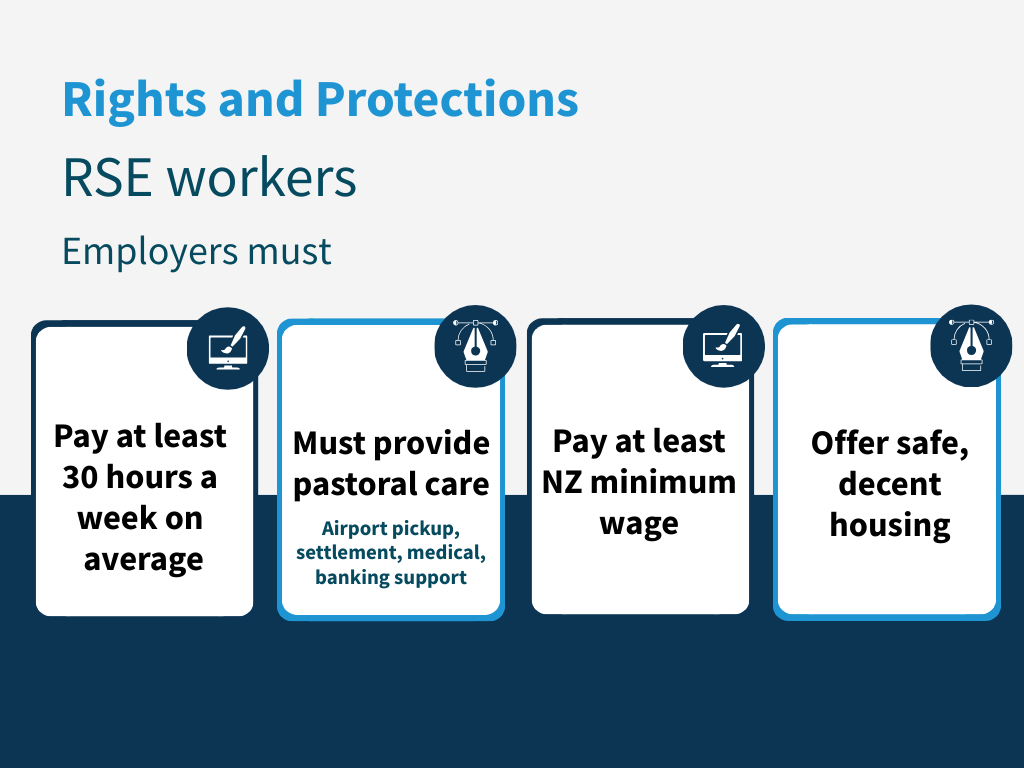
5. Arrival and Employment: Upon arrival, RSE workers begin their employment in roles such as planting, maintaining, harvesting, or packing crops. Employers are responsible for providing suitable accommodation, pastoral care, and ensuring compliance with New Zealand’s employment laws.
6. Departure: After completing their employment, workers must leave New Zealand before their visa expires. They cannot apply to stay longer while holding an RSE visa.
For the full guide from Immigration New Zealand on working as a Recognised Seasonal Employer worker, click here.
How to apply for the RSE visa?
Applying for the RSE Limited Visa involves several important steps. Below is a summary of the key requirements, but for the complete and most up-to-date information, you should always check the official Immigration New Zealand website
| 1. Secure a Job Offer | Obtain a job offer from a New Zealand employer who holds Recognised Seasonal Employer (RSE) status and a valid Agreement to Recruit (ATR). |
| 2. Complete the form INZ 1142 | Application to Work for a Recognised Seasonal Employer (INZ 1142). |
| 3. Gather Required Documents | • Passport • Photos • Signed employment agreement • Medical and police certificates |
| 4. Submit your Application | Submit your application offshore. Apply online through the Immigration New Zealand website. |
| 5. Pay the application fee | Currently NZD 325. Processing is usually fast, with most decisions made within two weeks. |
| 6. If the visa is approved | You’ll receive your visa, allowing you to work in New Zealand’s horticulture and viticulture industries for up to 7 months within an 11-month period. |
Remember, the RSE visa is employer-specific, meaning you can only work for the employer listed on your visa. Ensure you adhere to all visa conditions to maintain your legal status in New Zealand.
Benefits of the RSE Scheme
The RSE scheme brings real wins for workers, farms, and Pacific nations.
Here’s what it means:
For RSE workers
RSE workers in New Zealand are now guaranteed at least the minimum wage of NZD 23.15 per hour, while those returning for their third or subsequent seasons must be paid 10% above this rate (NZD 25.47 per hour). These rules, introduced in September 2024, remain in effect in 2025 to ensure fair pay for both new and experienced workers according to Immigration New Zealand.
For Employers
They get a stable, skilled workforce. Returning foreign seasonal workers often “hit the ground running”
For Pacific communities
Workers send earnings back home. That boosts families and local projects.
This makes the RSE scheme more than a labour program. It’s a shared benefit across borders—helping New Zealand farms thrive, and giving meaningful work to Pacific seasonal worker communities.
FAQ: Key questions about the RSE Scheme
1. What is the RSE scheme?
The Recognised Seasonal Employer (RSE) scheme allows New Zealand farms and vineyards to hire RSE workers from eligible Pacific nations when local workers are insufficient. Workers come on a seasonal worker visa NZ for up to 7 months in an 11-month period.
2. Which Pacific nations are eligible?
Eligible countries include Fiji, Kiribati, Nauru, Palau, Papua New Guinea, Samoa, Solomon Islands, Timor-Leste, Tonga, Tuvalu, and Vanuatu. Employers can only hire workers from these nations.
3. How much do RSE workers earn?
New RSE workers earn at least the New Zealand minimum wage (NZD 23.15 per hour). Returning workers in their third or later seasons earn 10% above minimum wage (NZD 25.47 per hour), Immigration New Zealand, 2024
4. How do I apply for the RSE visa?
Workers need a job offer from an RSE-approved employer and must apply using the RSE Limited Visa process. This includes submitting identification, proof of job offer, health checks, and insurance. For full details, see the official guide click here

About Rocket Remit
Rocket Remit is the world’s fastest international money transfer service. Send money instantly to over 60 overseas countries at very competitive rates.
Use the country selector to choose the country and check the rate.
Click here for more information on how to send money using Rocket Remit.
Download the Rocket Remit app from Google Play or the Apple Store
+ How much money can I send with Rocket Remit?
You can send up to AUD $1,000 per transfer and up to AUD $2,000 per day depending on your verification level and destination country. Limits may vary slightly between mobile wallets and cash pickup partners. If you need to send a higher amount, please contact our support team.
+ How long does it take for the money to arrive?
Most Rocket Remit transfers are instant — within minutes to mobile wallets. Bank or cash pickup transfers can take a few hours depending on the country and local partner. You’ll always see the estimated delivery time before confirming your transfer.
+ What are the fees for sending money?
Rocket Remit offers low, transparent fees shown clearly before you confirm your transfer. There are no hidden costs or deductions — your recipient receives exactly what you see. From time to time, we also run zero-fee promotions so you can send more for less.