Coping with Ramadan 2026 in a Non-Muslim country
Ramadan 2026 is coming. And for many, it will be quieter when you’re far from home.
No call to prayer echoing down the street. No crowded family tables. No whole city slowing down with you. For Muslims living in a non-Muslim country, Ramadan 2026 brings a unique set of challenges.
The first week of Ramadan is often the hardest (physically and mentally) as routines shift. This is completely normal.
But here’s the good news. Millions of Muslims around the world face this exact situation every single year. And they’ve found real ways to cope.
This guide is for them. And for you.
What is Ramadan 2026
Ramadan 2026 is predicted to begin around Tuesday, February 17, 2026, and is expected to end around March 19, 2026, depending on the moon sighting. Eid al-Fitr, the celebration at the end, follows shortly after, according to Islamic Relief Australia.
During Ramadan, Muslims fast from dawn to sunset. No food. No drink. Not even water. It is one of the Five Pillars of Islam. It’s a time for prayer, reflection, and spiritual growth.

So why does it feel so much harder in a non-Muslim country?
Fasting during Ramadan is “a million times more difficult” in a non-Muslim country “than back home.” Why? Being part of an environment or community where fasting is encouraged and accommodated can increase the likelihood of people fasting successfully. In some Muslim countries, accommodations are provided for fasting, which may not always be the case in the West.
Think about it. In Muslim-majority countries, the whole world adjusts. Shops close. Schools shift hours. Everyone around you understands.
In a non-Muslim country? Life goes on as normal. And you’re fasting in the middle of it.
The real struggles Muslims face while fasting at work
Still wondering why this is so tough? You’re not alone.
Fasting can lead to lower energy levels, especially towards the end of the day when Muslims have been without food or drink for many hours. This may result in decreased productivity, difficulty concentrating, and increased fatigue.
Here are the top challenges Muslims face while fasting in non-Muslim workplaces:
𖧹 Energy crashes: Afternoons hit the hardest. Concentration drops. Fatigue kicks in.
𖧹 Food is everywhere: Team lunches. Office cakes. Break room snacks. It’s impossible to avoid.
𖧹 Constant questions: “Wait, not even water?” It gets asked every single year.
𖧹 Feeling invisible: Your spiritual journey goes completely unnoticed by the world around you.
𖧹 Guilt and homesickness: Missing family iftars back home cuts deep. The difficulty of observing Ramadan away from home is one of the most common struggles Muslims talk about.

5 Real coping strategies that actually work for Ramadan 2026
The good news? People have figured this out. Here are five proven strategies to help you get through Ramadan 2026 in a non-Muslim country.
Pro Tip: If you’re specifically in Australia, we have a detailed guide on making the most of Ramadan down under.
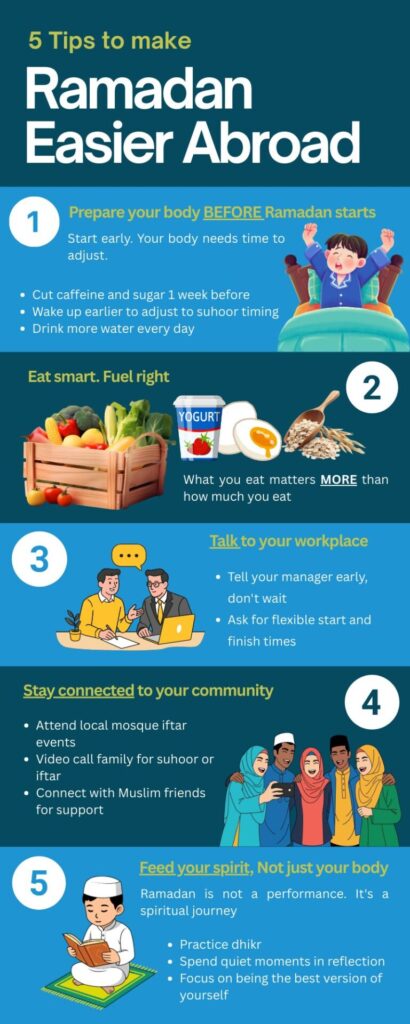
Millions of Muslims around the world are fasting with you. You are never truly alone.
How Non-Muslims can help
If you’re reading this and you’re not Muslim — thank you for being here.
Your small actions matter more than you know. Here’s how to show support:
Say “Ramadan Mubarak“
It means “Blessed Ramadan.” A simple greeting goes a long way.
Don’t hide your food
When food or drinks are deliberately hidden, it can unintentionally draw more attention to the fast. Just act normal.
Be flexible
Energy levels will drop. A little understanding goes a long way
Ask questions
Genuine curiosity shows respect.
Accept an iftar invitation
It’s a honour. And a beautiful experience.
The bottom line
Coping with Ramadan 2026 in a non-Muslim country is tough. There’s no pretending otherwise.
But it’s also an opportunity. A chance to strengthen your faith when no one else around you is doing it. A chance to build real resilience.
Send your support home this Ramadan 2026
One of the hardest parts of being away? Not being able to help your family back home.
But you still can.
This Ramadan, Rocket Remit is here to help you stay connected, so your care, generosity, and responsibility reach home safely and simply.
Because distance shouldn’t stop you from showing up for family. And giving is still a blessing, wherever you are.
FAQ: Your Ramadan 2026 Questions Answered
When is Ramadan 2026?
Ramadan 2026 is predicted to begin around Tuesday, February 17, 2026, and is expected to end around March 19, 2026, depending on the moon sighting. Eid al-Fitr, the celebration at the end, follows shortly after
When is Eid al-Firt?
Eid al-Fitr will likely be celebrated on Friday, March 20, 2026. But here’s the thing: the exact date depends on when the moon is sighted. So it could start on the evening of Thursday, March 19 instead.
What’s the best way to prepare for Ramadan 2026?
Start at least one week early. Don’t wait until the first day of fasting. Here’s your pre-Ramadan checklist:
-Physical prep: Cut down on caffeine and sugar now (trust us on this one). Start waking up earlier to adjust to suhoor timing. Hydrate well in the days leading up to Ramadan. Meal prep on weekends so you’re not scrambling during the week.
-Mental and spiritual prep: Set your intentions. What do you want to achieve this Ramadan?, Plan which Quran sections you want to read. Identify which bad habits you want to break
-Workplace prep: Let your manager know you’ll be fasting. Request flexible hours or remote work if possible. Block out your calendar for prayer times.
How do I deal with feeling lonely during Ramadan 2026 in a non-Muslim country?
This is one of the hardest parts. The loneliness is real.
But you don’t have to be alone:
𖧹Join online Ramadan communities. WhatsApp groups, Discord servers, Instagram communities, find your people.
𖧹Attend local mosque events. Many mosques host open iftar dinners. You don’t need to know anyone. Just show up.
𖧹Video call your family. Wake up for suhoor together. Break your fast together over FaceTime. It’s not the same as being there, but it helps.
𖧹Find Muslim coworkers or friends. Even one person who understands makes a huge difference.
Community is one of the strongest coping tools. You just have to reach for it.
How do I manage low energy at work while fasting?
Your energy will drop. Especially in the afternoon.
Fasting can lead to lower energy levels, especially towards the end of the day when Muslims have been without food or drink for many hours. This is completely normal. Here’s how to cope:
𖧹Talk to your boss early. Ask for flexible hours if possible. Many workplaces allow Muslims to start earlier and finish earlier during Ramadan.
𖧹Take short breaks. Step away from your desk. Walk outside. Move your body.
𖧹Pace yourself. Don’t overcommit during Ramadan. Save big projects for after the month if you can.
𖧹Stay spiritually focused. Use dhikr (remembrance of Allah) to stay mentally sharp and calm.
Your performance might not be 100%. And that’s okay. You’re doing something extraordinary.
About Rocket Remit
Rocket Remit is the worlds fastest international money transfer service. Send money instantly to over 60 overseas countries at very competitive rates.
Use the country selector to choose the country and check the rate.
Click here for more information on how to send money using Rocket Remit.