
There are plenty of reasons to start a business in Australia, a gap in the market, a skill you want to put to work, or simply the lifestyle. It isn’t always straightforward as a migrant, but plenty of people have done it before you.
Can immigrants start a business in Australia?
Yes, with a few conditions. At least one company director must be an Australian resident, a legal requirement under Section 201A of the Corporations Act 2001. A non-resident can still own 100% of the company, they just can’t be its sole director, a role commonly filled by a paid nominee director service if you don’t have an Australian resident to appoint.
Before you start: check your visa allows it
Not every visa lets you run a business in Australia, and the rules change more often than almost anything else here. Rather than list specific visa types, since that detail dates quickly, check your own visa conditions directly on the Department of Home Affairs website before you commit time or money to a business plan.
Practical setup steps unique to newcomers
Get a Tax File Number first.
You’ll need a Tax File Number (TFN) for your personal tax affairs before you register a business, it’s free through the ATO and generally needed before you can register for an ABN or GST.
Opening a business bank account can take longer without an Australian credit history.
Most banks require standard identity verification, but a longer track record with a personal Australian bank account tends to make business account applications smoother. Worth opening a personal account early if you haven’t already.
Super kicks in once you hire someone.
The superannuation guarantee currently sits at 12% of an employee’s ordinary earnings, and as of 1 July 2026 it’s paid alongside each payday rather than quarterly, under the new Payday Super rules. It’s not optional, budget for it from your first hire.
1. Research before you start a business in Australia
Before anything else, get clear on the basics: what’s the market like, who are your competitors, who’s your customer, and what mistakes do other businesses in this space commonly make. Books, local networking events and business.gov.au are all reasonable starting points.
Once you’ve got a handle on the market, a written business plan is worth the time. It’s not just paperwork, it forces you to prioritise goals, work out how you’ll allocate money, time and people, and gives any future staff or investors something concrete to look at. Business.gov.au’s plan template is a solid, free starting point.
2. Register your business
Registering online is straightforward, and the simplest structure, a sole trader, is free with no ongoing fees. A formal company costs more and usually needs a lawyer or accountant involved.
Whichever structure you choose, you’ll need:
- • A unique business name that isn’t already taken
- • A principal place of business in Australia
- • A defined business structure, sole trader, company, partnership, trust or co-operative
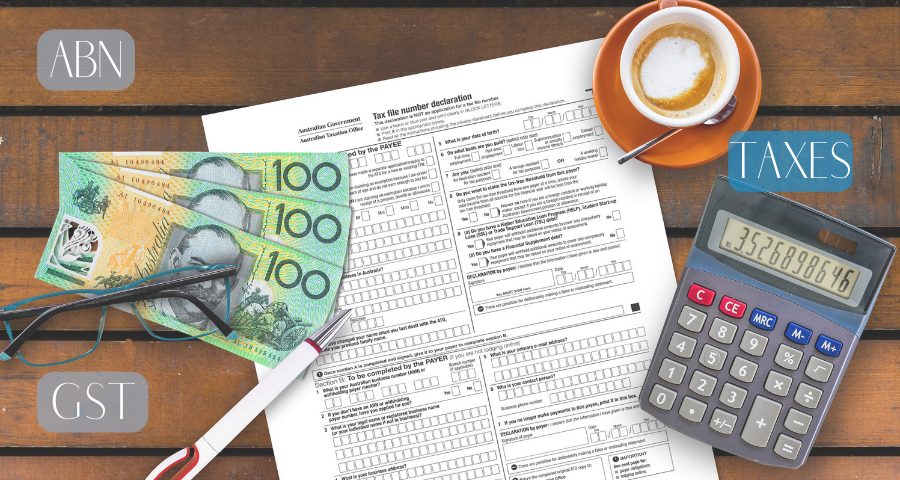
You’ll also need an Australian Business Number (ABN), free to apply for, and to work out which taxes apply to your business, including whether you need to register for Goods and Services Tax (GST), currently charged at 10% on most products and services.
3. Grants and support to start a business in Australia
A couple of grant programs that used to get recommended for this have since closed, the old Strategic Growth Loans program shut in 2023, and Victoria’s small business digital rebate scheme closed back in 2021. Here’s what’s actually current in 2026:
New Business Assistance with NEIS
A government funded program offering small business training, coaching and income support while you get a new business off the ground. Still running, still one of the more useful entry points for a first time founder.
Digital Solutions – Australian Small Business Advisory Services
Now in its third funding round, this gives small businesses access to low cost, one on one digital advice plus free workshops on things like online sales and cyber security.
Check business.gov.au’s grants finder tool
Rather than relying on any single named program, which can close without much notice, business.gov.au’s grants and programs finder is the most reliable way to check what’s currently open, federally and in your state.
4. Consider a not-for-profit instead
If your goal is community benefit rather than personal profit, a not-for-profit structure might suit better than a standard business. In Australia, that generally means registering with the Australian Charities and Not-for-profits Commission (ACNC), which oversees charities and requires ongoing reporting on how the organisation operates and spends its money.
It’s a different commitment to running a for profit business, less about scaling revenue, more about proving the organisation is genuinely serving its stated purpose. If that sounds like the right fit, the ACNC’s own starting guide is the best next step.
Frequently asked questions about starting a business in Australia
What do you need to start a business in Australia?
At minimum, an Australian Business Number, a business structure (sole trader is the simplest), and a business name if you’re not trading under your own legal name. If you’re a non-resident starting a company rather than operating as a sole trader, you’ll also need an Australian resident director.
Can I start a business in Australia with no money?
Sole trader registration is free, and so is applying for an ABN, so the paperwork itself doesn’t cost anything. What costs money is everything after that, stock, equipment, marketing, or staff, which is where the grants covered above can help cover some of the gap.
Can I run a business from home in Australia?
Yes, plenty of small businesses and sole traders operate from home, particularly in the early stages. Check your local council’s zoning rules if customers will visit in person, and make sure your home and contents insurance actually covers business use, since many standard policies don’t.
Do I need to register a business name?
Only if you’re trading under a name different from your own legal name (as a sole trader) or your company’s registered name. If Maria Santos operates as “Maria Santos,” no registration needed. If she trades as “Santos Cleaning Services,” it needs to be registered with ASIC, currently $47 for one year or $108 for three years.
Do I need an accountant or lawyer to start a business in Australia?
Not legally, most of the registration steps above (ABN, business name, GST) can be done yourself online at no cost beyond the ASIC fees. An accountant becomes genuinely useful once tax gets more complex, multiple income streams, employees, or a company structure rather than a sole trader, and many offer a free initial consultation worth taking up before you commit to one.
About Rocket Remit
Rocket Remit is the worlds fastest international money transfer service. Send money instantly to over 60 overseas countries at very competitive rates. Use the country selector to choose the country. Click here for more information on how to send money using Rocket Remit.
Click here for more information on how to send money using Rocket Remit.