Retiring in Australia: What it actually takes
You’ve already made the big move. You live here. You work here. Maybe you’re a citizen now, maybe a permanent resident. Either way, Australia is home. So now the question changes. It’s not “can I retire here?” It’s “what does retiring here actually look like for me?”
That question hits different if you’re in your 30s or 40s and migration is still a recent chapter, not a distant memory. The system runs on the same rules for everyone, same pension age, same super rules, same cost-of-living pressures. But building a retirement plan from scratch, in a country you didn’t grow up in, comes with its own questions.
When can you actually stop working? How much money do you need to save? And if your family, income, or savings still connect you to another country, how does that fit into your plan?
This guide breaks it down piece by piece, starting with the one question almost everyone gets wrong: what age can you actually retire in Australia?

What age can you actually retire in Australia?
Here’s where most people get confused. Australia doesn’t have one retirement age. It has two.
Preservation age
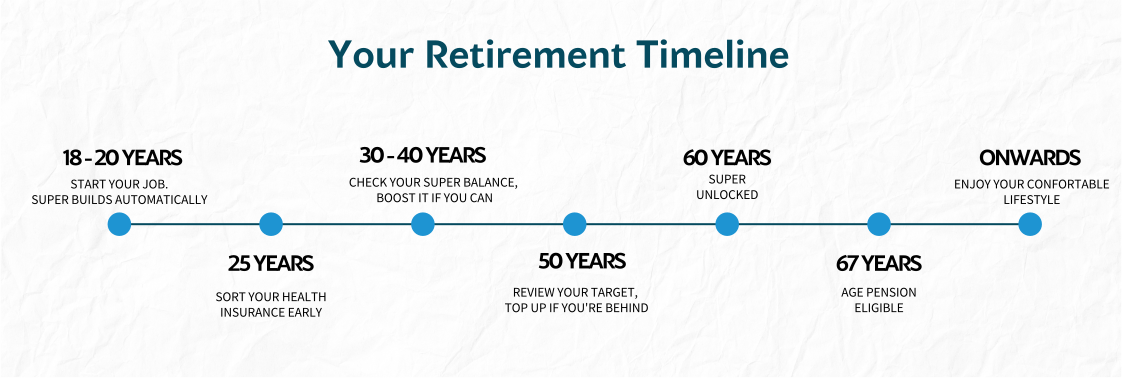
The first is your preservation age. This is when you can start accessing your superannuation. If you were born after 1 July, 1964, your preservation age is 60.
Age Pension age
This is when you become eligible for the government pension. Right now, that age is 67. It applies to everyone, no matter when you were born, as long as you were born on or after 1 January, 1957.
Super and the Age Pension aren’t the same thing
This is what confuses most people:
Super is your money.
Your employer builds it up over your working life, and it’s yours to access once you hit preservation age.
The Age Pension is different.
It’s government support, not your own savings, and getting it isn’t automatic. It depends on an income and assets test. If your super balance is high, your pension might be reduced, or you might not qualify at all.
So really, there are two milestones, not one. Sixty is when your own savings become available. Sixty-seven is when the government may step in to help too.
Knowing both numbers matters. It changes how you plan, how much you’ll need to save on your own, and when you can realistically stop working.
How much do you need to retire in Australia?
This is the question everyone wants a number for. And there isn’t one perfect answer. But there is a solid starting point. Most retirement guides talk about two lifestyle levels:
| modest lifestyle | comfortable lifestyle |
| A modest lifestyle covers the basics. Think housing, food, and bills, with little left over for extras. | A comfortable lifestyle gives you more room. Regular outings, private health cover, and the occasional trip away. Recent estimates suggest you’ll need several hundred thousand dollars saved to live comfortably from age 67. That number assumes you own your home and get a partial Age Pension. If you’re renting, or you plan to retire earlier, you’ll need more. |
Here’s the thing. These figures are averages, not rules. Your real number depends on where you live, whether you own property, and what kind of life you want.
If you have income or savings connected to another country, that changes your math too. Money moving across borders can lose value to fees and exchange rates. Over a long retirement, those small losses add up.
The takeaway? Start with the guidelines. Then build your own number around your actual life, not someone else’s average.
How to start planning your retirement now
Retirement might feel far away. But the earlier you start planning, the easier it gets. Here’s a simple checklist to work through.
1. Check your super balance.
Log in and see what you’ve got. If you’ve had a few jobs, you might have more than one account. Combining them can save you fees.
2. Look into transferring overseas retirement savings.
If you had a pension or super-style account before moving to Australia, check whether it can transfer here. Some countries have agreements with Australia, some don’t. It’s worth finding out early.
3. Think about housing early.
Will you fully own your home by retirement? Still paying it off? Renting? Your answer changes how much you’ll need.
4. Set a real target number.
Don’t just aim for “enough.” Use a free tool like the Moneysmart retirement calculator to turn your goal into an actual figure you can work toward.
5. Boost your super while you have time.
Extra contributions now, even small ones, have decades to grow. The earlier you start, the less you’ll need to add later. Check the Moneysmart Super calculator to help you know how much super you’ll have when you retire.
6. Think about housing and healthcare.
Will you fully own your home by retirement? Have you considered private health cover? Both shape how much you’ll need day to day.
7. Money across borders
If income, savings, or family support move between countries, build that into your plan. Fees and exchange rates can quietly shrink what you’re working so hard to save.
None of this needs to happen today. But starting the conversation with yourself now, even in your 30s or 40s, puts you ahead of most people.
Can you retire early in Australia?
Yes, you can. But early retirement means relying on your own savings for longer.
Remember those two ages from earlier? Sixty for your super, sixty-seven for the Age Pension. If you retire before 60, neither one helps you yet.
That means you’ll need other savings or investments to bridge the gap. Some people build this with a mix of shares, property, or cash savings outside super. Others reduce their hours gradually instead of stopping all at once.
Here’s the honest trade-off: retiring early sounds appealing, but it usually means saving a bigger number, not a smaller one. The extra years before 60 all need funding from somewhere.
If early retirement is your goal, start the math now. Knowing your gap years in advance makes them far easier to plan for.
Sending money home: What to know
Even after you’ve settled and retired here, your world might not stay entirely local. Maybe family is still overseas. Maybe part of your income or savings sits in another country.
That’s normal, and it’s worth a quick mention.
Sending money across borders isn’t free. Exchange rates shift, and fees add up. Over time, those small losses can chip away at money you worked hard to save.
If this applies to you, it’s worth using a service built for international transfers, not just your everyday bank. Rocket Remit is a money transfer company that helps you send funds from Australia to other countries, with clear fees and solid exchange rates.
Retirement planning is mostly about super and pensions. But if money still moves across borders for you, it’s one more thing worth getting right.
Your retirement, your terms
Retiring in Australia isn’t one big decision. It’s a handful of smaller ones, made early and made well.
Know your numbers: 60 for super, 67 for the pension. Set a target to save toward. Start planning now, even if retirement feels decades away. And if your life still stretches across borders, plan for that too.
You’ve already built a life here. With the right groundwork, your retirement can look exactly the way you want it to.

Quick Answers: Retiring in Australia
What age can you retire in Australia?
There’s no fixed retirement age, but two numbers matter. You can access your super at 60, and you become eligible for the Age Pension at 67.
How much money do you need to retire in Australia?
It depends on your lifestyle and whether you own your home. Recent estimates suggest several hundred thousand dollars for a comfortable retirement from age 67, assuming you own your home completely.
Can you retire early in Australia?
Yes, but you’ll need other savings to cover the years before 60, since super and the Age Pension aren’t accessible yet.
How do you start planning for retirement in Australia?
1. Check your super balance
2. Set a savings target
3. Look into extra contributions
4. Consider housing and healthcare costs early.
The earlier you start, the less you’ll need to add later.
What’s the difference between superannuation and the Age Pension?
Super is your own savings, built up over your working life and available from age 60.
The Age Pension is government support, available from 67, and only if you pass an income and assets test.
About Rocket Remit
Rocket Remit is the world’s fastest international money transfer service. Send money instantly to over 60 overseas countries at very competitive rates.
Use the country selector to choose the country and check the rate.
Click here for more information on how to send money using Rocket Remit.
Download the Rocket Remit app from Google Play or the App Store